
The harm inflicted by Confederate monuments
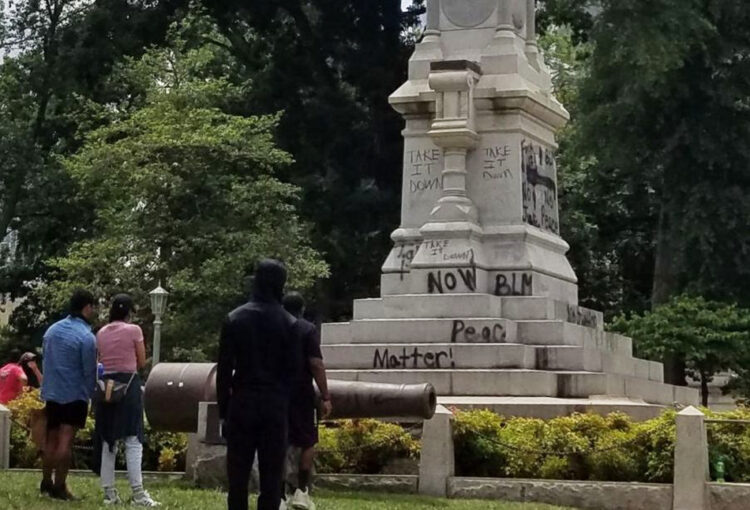
The North Carolina Confederate Monument was dismantled at the State Capitol in June 2020 | Photo: Clayton Henkel
April 14. [Analysis] By Kelan Lyons/NC Newsline. Every October, Ronda Taylor-Bullock’s hometown would come alive on Goldston’s Old Fashion Day. Vendors would line the streets of the small rural community, selling wares and performing music. But there was one booth that wasn’t for her, a Black child. It made her feel unsafe, even though no adults had explicitly told her to stay away.
It was filled with Confederate memorabilia.
“I knew in my body, it was time to turn around and go back,” she said. “We carry history in our bodies. My ancestors told me, ‘It’s time to go back.’ As a child, I knew that.”
Taylor-Bullock, the co-founder and lead curator of we are, who gives children and adults anti-racist training, was one of four panelists convened Thursday morning at Shaw University by the NC Commission on Racial and Ethnic Disparities in the Criminal Justice System, known as NC CRED. The goal of the all-day symposium was to help attendees grapple with the harms inflicted by the Confederate monuments so that they can understand why they should be removed.
“In this battle for justice and equality and freedom, sometimes you just have to name it,” said James Williams Jr., the board chair of NC CRED. “And we are here today to help name ‘harm’ as another reason that these monuments should be removed.”
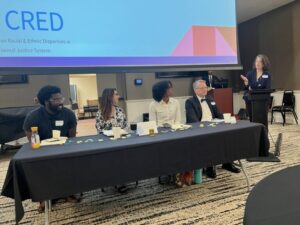
Panelists at a symposium on the lasting harm inflicted by Confederate monuments, hosted by NC CRED at Shaw University on April 13
Taylor-Bullock was joined by fellow panelists UNC law professor Deborah Gerhardt, poet Cortland Gilliam, who is also pursuing a doctorate at the UNC School of Education; and Gaston County Chief Public Defender Stuart Higdon.
Not just steel and stone
Each shared their thoughts on the belief that Confederate monuments are not mere steel and stone, but a form of white supremacy that continues to inflict suffering on Black North Carolinians.
Williams, a former public defender, said monuments outside of courthouses were particularly antithetical to the values of fairness and equality that are supposed to be espoused in the buildings that dole out justice.
Higdon discussed one monument in particular: A Confederate soldier outside the Gaston County courthouse. The statue was was originally erected in 1911 across the street but was moved 87 years later to the courthouse grounds in 1998. At the 1912 dedication of the monument, someone gave a speech stating the white race was the superior race, Higdon said, which makes it hard to claim the statute is about heritage or a monument to the Confederacy.
Across the street from the courthouse is an obelisk commemorating Martin Luther King, Jr., roughly six feet high.
“The soldier towers over it,” Higdon said, estimating that the Confederate statue was just two feet shorter than a flagpole on the same site.
Considering the racial disparities in the criminal justice system — from police shootings to cash bail to sentencing outcomes — the presence of a statue of a Confederate solider literally looking down on Black defendants as they enter a courtroom does little to assure a person that they will get a fair trial.
“I think it’s important that we address symbols: when people come into a courthouse, that they think they’re playing at a neutral site, that they’re not playing an away game,” Higdon said. “That they come here and they do have the ability to redress wrongs, get justice, and be treated fairly.”
Background: Silent Sam
Courthouses weren’t the only buildings under scrutiny; so was the state’s flagship public university, UNC-Chapel Hill.
Gilliam described himself as a “literary voice” in the movement to remove the Silent Sam Confederate monument from the UNC-Chapel Hill campus. He would recite poetry and write speeches at rallies. Eventually, he decided to wear a noose around his neck as he walked around campus.
Anti-racist demonstrators toppled the statue mere hours after protestors held a rally to announce the noose protest, in December 2018. But then the campus Board of Trustees announced a proposal to re-erect the state in an “educational center” at a cost of $5 million. Gilliam wound up wearing the noose any time he walked around campus, until September 2019.
Gilliam is skeptical the university would have removed Silent Sam if protestors hadn’t taken it down themselves. After all, there had been calls to topple it since UNC started admitting Black students.
“There is no systematic removal of that statue, ever,” He said. “There’s a reason why it stood for over 100 years. And that’s because that institution is tied to particular donors and funders.”
Gerhardt said the presence of Confederate monuments on courthouse or school grounds create a “racially hostile environment.” But removing the monuments isn’t enough, she said. There should also be a memorial, an acknowledgement of the injustice — a healing and amends through remembering past wrongs.
“We need to do more,” Gerhardt said. “The walls surrounding the campus were built by slave labor, and there’s no indication of that.”
Visceral feelings on both sides
Taylor-Bullock, a critical race scholar who has conducted studies on whiteness and white children’s racial identity construction, said Confederate monuments can stir complex psychological feelings in white people.
“These monuments of hatred contribute to feelings of superiority,” Taylor-Bullock said, which explains the visceral reaction many white people have to their removal. “If we’re destroying monuments in some form or fashion, some white people are processing that as a loss of their identity, to their belief that they are superior.”
Taylor-Bullock’s work involves helping children develop healthy racial identities, a mission made more difficult by the messages young children receive from places like mass media, books and Confederate statues. Black children see, say, a white Confederate soldier looking down on them outside the Gaston County courthouse and think, “There aren’t any statues that look like me towering over my community.”
Meanwhile, Taylor-Bullock said, the message white children receive is that they are superior because those remembrances, those shrines, are of people who look like them. To believe they are the dominant race, to carry that hate in their heart, is a heavy burden, Taylor-Bullock said. But it is also a burden for Black children to live every day in a state that honors white men who went to war so they could continue to own people who look like them as property.
“It’s just important that we understand that this is not just an adult conversation,” Taylor-Bullock said. “We have to think about the children that we want to raise.”
Next week, NC Newsline will publish another story about Confederate monuments: the consequences of removing them, and the ways that entrenched white supremacy can rally to keep them in place.
No Comments
Leave A Comment Cancel reply
Our Partners









This symbol of hate and shameful history reflects on every person living in Cornelius. Is that what defines you?
I think monuments should remain, BUT. There needs to be signage describing the person and history. You know, you see signs like that in National Parks, Blue Ridge Parkway, etc. Eliminating history does not change it. All it does is mask it’s existence and leave us open to repeat mistakes of the past.
If we are going to remove all that is offensive then let’s go! The White House, The Washington Monument, Lincoln Memorial, Jefferson Memorial and hey even Mount Vernon.
I could go on but you get the idea. Historical perspective is important for future generations to understand the past. So much is simply forgotten or glossed over.
Union and Confederate monuement were erected by the communities over thier community’s losses. This is clearly stated on the monuemnts themselves with “our dead” and other sentiments. Confederates represents more of a mourning sentiment while Union often portray the efforts were to “preserve the Union.” Their appearace is more related to the various anniversaries of the war (on both sides) than other factors. Fundraising takes time, and the rise of Southern monuments is delayed in part from lack of funds for such memorialzation. Monuments are to tell their story as a bookmark where one can then go look up the history on your own for more details. I’ve visited over 200 Confederate and a few dozen Union monuments in my research since publsihing my 2019 article “Forever in Mourning.” https://www.academia.edu/41329543/Forever_in_Mourning_Union_and_Confederate_Monuments_1860_1920 which I’m expanding do a doctoral dissertation