
Aug. 10. [Opinion] Since the owners don’t want to remove it, I wonder if there is a way to turn the Confederate Monument into a symbol of forward motion, as a tool to teach and learn from history?
Taking it down doesn’t erase history, and vandalizing it doesn’t change its original intention from 1910. Can we embrace it, expose it, and rewrite what it means NOW? In 112 years, what has changed for the better? These symbols only hold the power they are given; so take away its power. 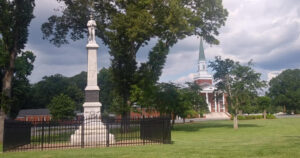
It reads: “THOUGH MEN DESERVE / THEY MAY NOT WIN SUCCESS / THE BRAVE WILL HONOR THE BRAVE / VANQUISHED NONE THE LESS.”
They lost that fight, they did not succeed in their attempt to keep the Black community down. The brave are NOT them, or those like them.
The brave are the ones who push forward every day to fight a good fight, even if it is to gain an inch at a time, for equality for ALL people.
—Jennifer Claussner, Cornelius


I’d propose a larger monument that surrounds or blocks the front view. Maybe something that promotes the unity (and shared resources) that the Town is trying to achieve with recent proposals and grants.
I agree with Jennifer… we can’t erase or change history so let’s learn from it and celebrate the good changes that have been made and push forward
Maybe Cornelius Today could do an article about the history of the monument – which is somewhat unique in that it was erected not to honor the political or military leaders of the Confederate States, but rather the regular men that volunteered to defend their state and who fought and died. The grounds of Mt. Zion church where the monument stands was the site of a huge annual soldiers’ reunion for many, many years. When Cornelius had less than 2,000 citizens the annual reunion amassed over 10,000 attendees from all over the Southeast. Maybe knowing the details would help people understand the historical significance of the monument.
Unity in Community, which called for the removal of the monument, responded to Ms. Claussner:
I would like to thank Jennifer Claussner for her very thoughtful Letter to the Editor, published on August 10, 2022. Speaking on behalf of Unity in Community (UiC), we agree with many of Ms. Claussner’s points. However, UiC’s goal has been – and continues to be – the removal of the Confederate monument in Cornelius.
Whether taking down the monument erases history or not, has been a point of contention. We strongly agree with Ms. Claussner that taking it down does not erase history. The monument itself is not history. It represents the people who put the statue there and their values and beliefs at that time. It doesn’t tell the whole story. It doesn’t represent the values of those who fought and died to end slavery. And it does not represent “the Cornelius way” of today. That “way” is, one of equity and inclusion by “creating an environment where all citizens feel safe and respected.”
Ms. Claussner correctly states that vandalizing the monument doesn’t change its original intention. Thus, we do not advocate vandalism and believe that it’s important to explicitly state the original intention, which was to glorify White Supremacy and instill fear and intimidation in Black people. Again, Ms. Claussner is correct that they did not succeed in keeping the Black community down – the Smithville community is a testament to that. Despite 50 years of neglect and numerous attempts to erase the community, Smithville has survived and is now poised for a much-needed revitalization.
UiC continues its efforts to expose the history behind the monument and the reasons why the monument must be removed (https://uic-nmeck.org/wp-content/uploads/ConfMonument_FAQs_011022.pdf. However, that the monument is still standing means that it continues to hold power – it continues to stand prominently as a symbol of White Supremacy. To take away its power, we must take down the monument.
We thank Ms. Claussner for contributing to the conversation around the monument by sharing your perspective and we hope that Ms. Claussner and other residents of Cornelius, N. Meck, and beyond will join UiC in calling upon the Mt. Zion Monumental Association to take down the monument.