Full funding announced for Lyngbya eradication
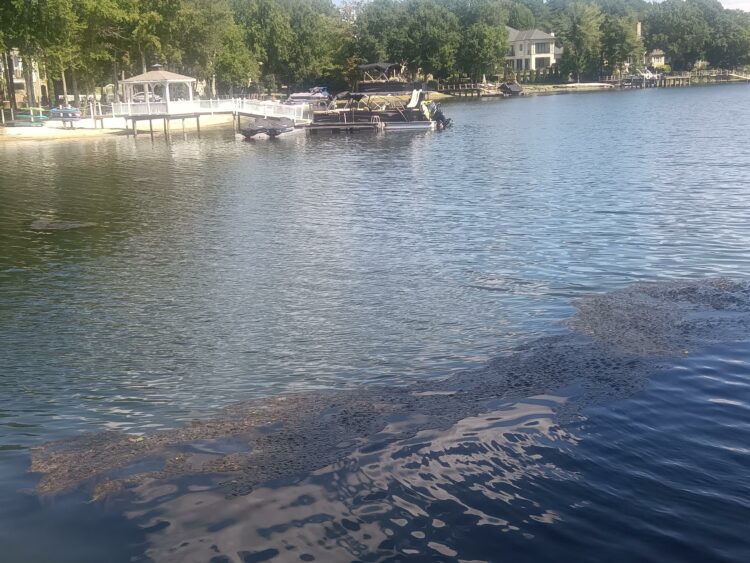
Lyngbya in lake adjacent to the 18th hole at The Peninsula Club
Feb. 15. The community-organized Cornelius Water Project announced today that the 2024 Lyngbya Eradication Project for Lake Norman has been fully funded. Investments from Charlotte Water, the City of Charlotte, and Duke Energy along with Catawba, Iredell, Lincoln, and Mecklenburg Counties have provided all the funding required for the 2024 treatments.
Some $15,000 has already been raised, mostly from private individuals with some relationship to the lake, but now, local governments and agencies are stepping in and the $15,000 wikll be returned to private donors.
Background
The initiative to raise awareness of the threat to Lake Norman water quality began last September when Bob Watson, a Cornelius resident, saw a black sludge-like mat floating on the water in the cove behind his home. Watson gathered federal, state, and local government officials along with community leaders and concerned citizens to meet with representatives from Charlotte Water and Duke Energy.

Menzel
Bob Menzel, another Cornelius resident, attended the meeting and the two men quickly recognized the Lyngbya cyanobacteria (blue-green algae) presented a clear and present danger to Lake Norman water quality. Together, they began a campaign to raise awareness and build support to confront and combat the problem.
The North Carolina State University estimated $60,000 would be needed to treat Lyngbya in Lake Norman in 2024.
Marine Commission will manage project
Full funding was confirmed Monday evening at the monthly meeting of the Lake Norman Marine Commission which said it would manage project funding and administration in partnership with the NCSU Aquatic Plant Management Program.

Watson
Quotable
“The prompt and generous support from so many of our neighbors was amazing! It speaks volumes about what makes our community a truly remarkable place to live and call home,” Watson and Menzel said in a prepared statement.
Looking ahead
The North Carolina House of Representatives and Senate are preparing to pass legislation that will result in funding for Lyngbya eradication in 2025 and beyond. It is estimated that a four-year treatment program will be required for practical eradication.
Annual monitoring will continue indefinitely.
Watson and Menzel credited a variety of officials for their timely help, including: Sen. Thom Tillis and his staff, NC House Speaker Tim Moore, Rep. John Bradford, Sen. Vickie Sawyer, Former Senator Jeff Tarte, Mecklenburg County Commissioner Elaine Powell, Lincoln County Commissioner Bud Cesena, Cornelius Mayor Woody Washam, Ron Hargrove of Charlotte Water, Dr. Brett Hartis and Eryn Molloy of Duke Energy, Chairman of the Lake Norman Marine Commission Rick Howard, LNMC Executive Director David Scott and John Gerke of LNMC, Dave Ferguson of Charlotte Storm Water Management, Brandon Jones of Catawba Riverkeeper, Rob Richardson and Jessica Baumann of the North Carolina State University Aquatic Plant Management Program among others.
Treatment timetable
Lyngbya cyanobacteria (blue-green algae) treatments are scheduled to begin in April.
If you see it
Citizens who suspect the presence of Lyngbya in the water near their property can report concerns to the Duke Energy Aquatic Plant Management Program using this link from the Duke Energy website Aquatic Plant Report – Duke Energy (arcgis.com). The scientists of Duke Energy work closely with the Lake Norman Marine Commission and the North Carolina State University Aquatic Plant Management Program and will communicate these reports for follow-up.
No Comments
Leave A Comment Cancel reply
Our Partners








Many thanks to both Bobs—Menzel and Watson for organizing this important effort to protect our Lake from a bad invasion. Raising money for eradication wasnt easy but many responded. Cudos all around. CGray
Kudos to both Bobs for their leadership and commitment to nipping this problem in the bud!
There is no mention of the suspected cause of this toxic algae bloom? It seems that it could be aggravated by nutrients in fertilizer runoff. If so, an ounce of prevention is worth a pound of cure.
Jim, thank you! We had a lot of help in raising awareness that was critical to communicating the urgency of the situation. Thank you for your support!
Thank you, Carroll! And you are correct, this was possible because of widespread community support. Thank you for you support!
Occasionally, I hear folks exclaim, “one person can’t make a difference”. Bob Watson and Bob Menzel certainly demonstrated one, or two in this case, can make a difference as they did in rally experts and the community to get ahead of a potentially serious lake threat.
Grant, thank you for your comment and, like you, we thought that was the case. We have since learned (and we’ve learned a lot) that the nutrients were there when the lake was formed. Lyngbya is a native species and for a variety of reasons began expanding in the lake in 2022. Fortunately, it’s been recognized early and treatments are scheduled to begin in April.
This is great news!! A big thank you to all that made this happen!!
Scott, as a neighbor who has worked successfully on important issues for our Town, we are grateful to receive your kind comment! All best wishes to you and the Board!
Carrie, thank you for your comment. Thank you, too, for your support!