
Task force forming to attack Lyngbya, a growing problem
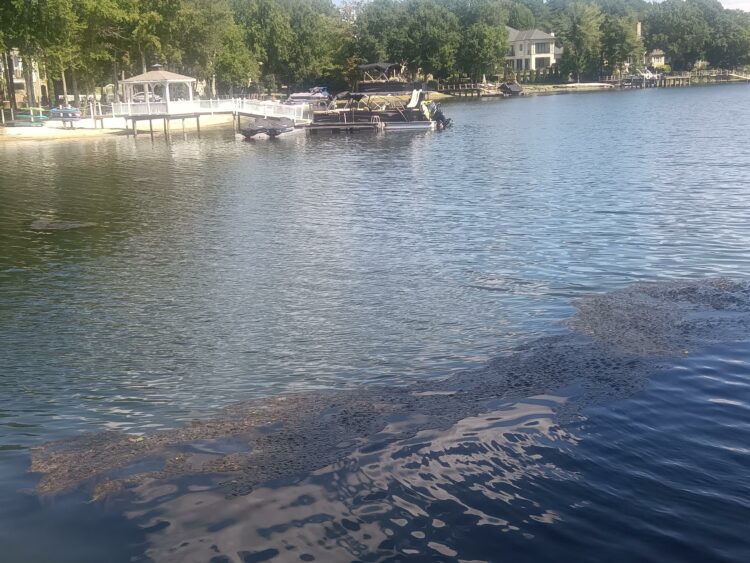
Growth in lake adjacent to the 18th hole at The Peninsula Club
Sept. 27. By Dave Yochum. In the wake of a meeting at The Peninsula Club yesterday, local leaders will form a task force on a problem that is literally growing. Algae blooms known as Lyngbya wollei are apparently a threat to Lake Norman on the order of Hydrilla.
Former NC Sen. Jeff Tarte said state monies are available to fight the problem which has affected property values in other areas.
“In my last year in the Senate I had a bill passed that makes available $500,000 annually to specifically fight this type of problem in our lakes,” Tarte, a Cornelius lakefront resident, said. “And we do not spend anywhere near that much money each year on these concerns. So money is available.”

Jeff Tarte at a Newsmakers Breakfast
Mayor Woody Washam compared the situation to hydrilla, a lakewide concern ameliorated by stocking the lake with sterile grass carp.
“It is time to utilize already approved state funding to implement new and innovative methods of treatment to solve this ongoing problemn for our entire lake once and for all,” he said.
Neighbor to neighbor won’t work, Tarte said.
One of the forms of treatment is ultrasound waves, generated by underwater speaker systems.
Unsightly, smelly
Lyngbya forms large, dense mats that float on the surface. It can impact water intake at Duke Energy’s
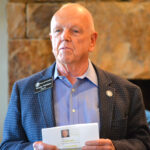
Mayor Washam
McGuire Nuclear Station.
While there is no evidence of serious detrimental human or animal health effects caused by Lyngbya, it affects appearance and swimability, not to mention property values.
Resident Bob Watson, who lives on a cove just north of the clubhouse at The Peninsula Club, spent several hours raking Lyngbya mats out of the lake to dry and kill it—will organize the task force.
Tarte, who recommended a regional approach to the problem, is already on board.

Bob Watson
Attendees—there were more than 50 people there—included officials from Storm Water Services, as well as officials from Duke Energy and a representative from US Sen. Thom Tillis’ office.
Cyanobacteria
Lyngbya, which has recently been reclassified and renamed Microseira wollei, is a cyanobacteria, or blue-green algae. It has the capability to produce toxins, however, the types of toxins produced by Lyngbya are not well studied or known. A common effect is a rash on the skin.
8 Comments
Comments are closed.
Our Partners








How does one get information concerning the task force and how to participate?
We’ll sendyour info on to Mr. Watson.
We would also like some information on the task force to combat in lyngbya woolei. Dick Storey, Baybridge Homeowners Association. thanks for your help
Re the seaweed task force, I am interested in Mr. Watson’s contact info. Can he please text me at 704-425-3615?
Thank you.
We’ve sent your info to Mr. Watson
Send your email to Bob Watson
Robertewatson1958@gmail. Com
I can put u with the group
Thanks
A heartfelt thanks to Mr Watson and Mr Tarte. I reached out various agencies over the summer about the problem with very little success! Thanks for your hard work!
Until about 15 years ago, this lake was crystal clear and nothing bad was growing in the water. Now the water is no longer clear with unsightly growth everywhere. What is the cause? Maybe all the fertilizer used the yards, golf courses, etc. and street pollution from storm drains? I believe the problem needs to be addressed by what’s going into the lake to cause this growth, not just trying to clean up after the damage is done.